

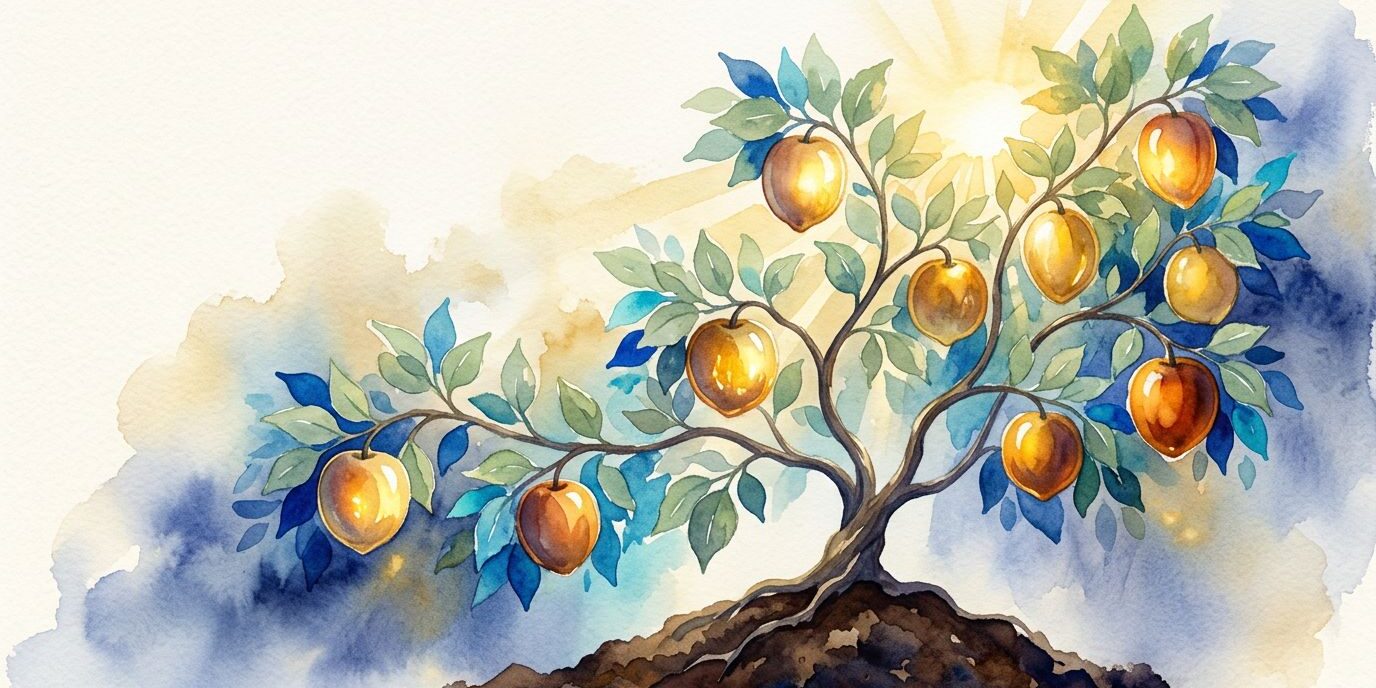
Galatians 5:22-23 speaks to a Christian who knows the right response yet feels anger, fear, or impatience rising. The fruits of the spirit show what the Holy Spirit grows in us through ordinary pressures and difficult seasons.
The list includes nine qualities: love, joy, peace, patience, kindness, goodness, faithfulness, gentleness, and self-control. I don’t read these traits as a scorecard for perfect Christians. I see spiritual fruit as evidence of God’s work in a growing life.
Key Takeaways
- The fruits of the Spirit in Galatians 5:22-23 are love, joy, peace, patience, kindness, goodness, faithfulness, gentleness, and self-control.
- Paul presents these qualities as one fruit with nine expressions, produced by the Holy Spirit rather than earned through religious performance.
- Spiritual fruit grows in people who remain connected to Christ and depend on the Holy Spirit through ordinary choices, prayer, and obedience.
- Difficult relationships, stress, and hardship often reveal where spiritual growth is needed and provide opportunities to practice Christlike character.
- Christian freedom is not permission for selfishness; it frees believers to love, serve, forgive, and obey God.
Galatians 5 gives the biblical setting
Galatians 5 gives the biblical setting for Paul’s discussion of Christian freedom and life through the Holy Spirit. You can read Galatians 5 in context in the New International Version to see how this biblical text connects spiritual character with daily conduct.
Why Paul wrote to the churches in Galatia
The Apostle Paul wrote Galatians to Christian congregations facing confusion about salvation. Some teachers claimed that Gentile believers needed to follow Jewish laws, including circumcision, to belong fully to God’s people.
Paul defended salvation through faith in Jesus Christ. He also made clear that freedom from legalism isn’t permission to live selfishly. This freedom shapes the Christian life, helping believers love God and serve others through the Spirit.
That setting matters because spiritual fruit isn’t a list of moral achievements earned through religious performance. It grows in people who belong to Christ and trust the Spirit’s work.
The contrast between the flesh and the Spirit
Earlier in Galatians 5, Paul contrasts the “acts of the flesh” with spiritual fruit. The flesh, or sinful nature, points to desires and behaviors that damage our relationship with God and other people. The Spirit produces a life shaped by God’s character.
Paul describes the flesh’s actions as acts, while he describes the Spirit’s result as fruit. These acts can multiply through repeated choices, but fruit grows from a living source.
Christian freedom has a direction. It frees you to love, serve, forgive, and obey God.
What are the fruits of the spirit in Galatians 5?
The nine qualities listed in Galatians 5:22-23 are love, joy, peace, patience, kindness, goodness, faithfulness, gentleness, and self-control.
Some Bible translations use “forbearance” instead of the term describing endurance, which means facing difficult people or circumstances without returning evil for evil. The passage concludes with the final two qualities in verse 23.
One fruit with nine expressions
Paul uses a singular image, “fruit,” even though he names nine qualities. This wording presents one fruit of the Spirit with several visible expressions, all formed by the Holy Spirit.
A person may show one expression of spiritual fruit in a situation but struggle in another. Growth in spiritual fruit often happens unevenly. Still, the goal is a whole person shaped by the character of Christ, not a single impressive trait.

Photo by Matthew Hernandez
Love, joy, and peace
These first three qualities show how the fruit of the Spirit shapes our relationships with God and others. They also shape our response to circumstances, forming spiritual fruit that supports the other six qualities.
Love chooses another person’s good
The Greek word agape appears in Galatians 5:22. It describes agape love as purposeful and self-giving, rather than mere attraction, affection, or personal preference. I understand this love as a decision to seek another person’s good, because God showed us this care first.
This love tells the truth without cruelty. It forgives without pretending that harm never happened. It also reaches beyond close friends and family, extending love to people who cannot repay us. Paul’s description in 1 Corinthians 13 shows how this care acts with patience and humility, making spiritual fruit visible in relationships.
You can review Greek notes on agape in Galatians 5:22 for additional background on the word.
Joy remains connected to God’s care
Joy is more stable than a pleasant mood. Feelings change with health, finances, relationships, and news. Biblical joy rests on God’s presence and promises, so it can remain even when life feels painful.
It doesn’t require pretending that grief is small. Jesus wept, and the Psalms contain honest sorrow. Still, that perspective helps me remember that hardship doesn’t have the final word. Worship, gratitude, and fellowship can help us receive that perspective again.
Peace steadies the heart
Peace includes reconciliation with God and a settled trust in His care. It also affects the way we handle conflict. A calm person doesn’t need to win every argument or answer every insult.
Peace isn’t passivity. It can lead to an honest conversation, a wise boundary, or a courageous decision. During stress, I slow down, pray for wisdom, and choose words that bring clarity, preserve inner calm, and reduce heat.
Patience, kindness, and goodness
These expressions of the fruit of the Spirit become visible in how we treat people, especially when no one responds as quickly or kindly as we hoped. Love shapes these responses, and spiritual fruit often appears in ordinary moments.
Patience makes room for growth
Patience helps us endure delays, weakness, and repeated problems without surrendering to irritation. Parents need it during exhausting seasons. Singles need it when loneliness or uncertainty grows. Every believer needs it when another person’s progress feels slow, as spiritual fruit often grows through repeated, ordinary choices.
A patient spirit doesn’t require anyone to remain in an unsafe situation. Healthy boundaries and wise action can exist alongside a patient spirit. The goal is to respond without revenge, contempt, or unnecessary anger.
Kindness turns concern into action
Kindness is more than having good intentions. It may look like listening without checking your phone, bringing a meal, sending an encouraging message, or helping someone solve a practical problem.
Small actions matter because people often recognize God’s care through ordinary believers. An encouraging word at work, a thoughtful response at home, or a generous act toward a neighbor can open a door for hope.
Goodness chooses what is right
Goodness includes moral integrity and active concern for what honors God. It means refusing dishonest shortcuts, speaking up for someone treated unfairly, and doing the right thing when there is no public reward.
Kindness may comfort a person, while moral clarity may also challenge a harmful choice. Jesus showed both compassion and moral clarity. Spirit-led goodness never uses truth as an excuse for cruelty.
Faithfulness, gentleness, and self-control
The final three fruits show how spiritual maturity shapes trust, strength, and personal discipline through the fruit of the Spirit. Together, this spiritual fruit becomes visible in how we relate to God and others.
Faithfulness keeps showing up
Faithfulness means reliability toward God and people. It includes keeping promises, serving when the task feels ordinary, and continuing in prayer when answers take time.
Families experience it through consistent love and presence. Friends experience this quality when you keep confidence and offer support during hardship. Churches need it from people who serve without constant recognition.
Gentleness uses strength with care
Gentleness isn’t weakness or fear. It is strength under control. A gentle person can correct someone without humiliating them and disagree without treating the other person as an enemy.
This quality matters during political arguments, family tension, and online conflict. Before responding, I can ask whether my words will help someone hear truth or only prove that I am angry. Gentleness protects both honesty and the dignity of the person in front of us.
Self-control directs desire
Self-control helps us govern impulses rather than obeying every feeling. It affects speech, spending, sexuality, eating, anger, entertainment, and the use of time.
This discipline doesn’t mean relying on willpower alone. The Holy Spirit changes our desires and gives strength to choose obedience. We still make real decisions, but spiritual fruit grows as we choose God’s help instead of depending only on emotion.
How spiritual fruit grows in everyday life
No one produces spiritual fruit through self-improvement alone. I can practice better habits, but the fruit of the Spirit grows as the Holy Spirit transforms me. The Apostle Paul points believers toward transformation by remaining connected to Christ. Jesus’ teaching about the vine and branches in John 15 gives the same picture: fruit comes from remaining connected to Him.
A daily practice for difficult moments
When I want to cultivate a particular fruit of the Spirit, I use a simple pattern:
- I read Galatians 5:22-23 and identify the quality I need most.
- I name the situation that is testing it, such as a tense conversation or a stressful deadline.
- I ask the Holy Spirit for help before reacting.
- I choose one obedient action, such as listening, telling the truth, delaying a reply, or offering practical help.
- I review the moment that night and bring both failure and progress to God.
This process also supports emotional regulation. Pausing, naming what I feel, praying, and choosing a measured response creates space between a trigger and an action. Christian growth depends on the Spirit, so this practice is more than a technique for managing emotions.
Hardship reveals where growth is needed
Severe hardship can expose the fruit that needs attention. Burnout may reveal a lack of self-control around rest and boundaries. Grief may call for peace and patient trust, followed by a return to peace after disruption. Conflict may require faithfulness, gentleness, goodness, kindness, patience, and love at the same time.
At the end of the day, I find these questions useful: Which fruit was hardest to practice? What triggered my reaction? What would obedience look like next time? Who can pray with me and offer honest encouragement?
The goal isn’t to condemn yourself after every failure. Confession, forgiveness, and another faithful step are part of growth. Over time, repeated dependence on the Spirit supports spiritual growth and lets spiritual fruit shape our spiritual life.
Frequently Asked Questions
What are the fruits of the Spirit?
The fruits of the Spirit are nine qualities listed in Galatians 5:22-23: love, joy, peace, patience, kindness, goodness, faithfulness, gentleness, and self-control. They show the character the Holy Spirit develops in a believer’s life.
Why does Galatians use the word “fruit” instead of “fruits”?
Paul uses the singular word “fruit” to present these nine qualities as different expressions of one work of the Holy Spirit. A believer may grow unevenly, but the goal is a whole life increasingly shaped by Christ’s character.
How does spiritual fruit grow in a Christian’s life?
Spiritual fruit grows as believers remain connected to Christ, ask the Holy Spirit for help, and practice obedient responses in daily situations. Prayer, Scripture, honest reflection, and faithful choices support this growth, but the Spirit remains the source of transformation.
Are the fruits of the Spirit a way to earn God’s acceptance?
No. The fruits of the Spirit are not a scorecard or a way to earn salvation; they are evidence of God’s work in a life connected to Christ. Christian growth includes both progress and failure, followed by confession, forgiveness, and another faithful step.
Can patience and gentleness exist alongside healthy boundaries?
Yes. Patience does not require someone to remain in an unsafe situation, and gentleness is not weakness or passivity. Wise boundaries, honest conversations, and courageous action can all reflect the Spirit’s work.
Conclusion
The fruits of the spirit are love, joy, peace, patience, kindness, goodness, faithfulness, gentleness, and self-control. They are not a religious performance or a way to earn God’s acceptance. The fruit of the Spirit is visible in a life connected to Christ and led by the Holy Spirit.
This spiritual fruit reflects the character of Christ and grows through choices made in everyday life. When pressure brings anger or fear to the surface, you can pause, pray, and choose love in your next response. If you need prayer or a church community in Webster, Texas, contact Praise Chapel for prayer and ministry information or call Praise Chapel at (281) 338-6633. Growth in spiritual fruit may take time, but God continues forming Christlike character in willing hearts.