

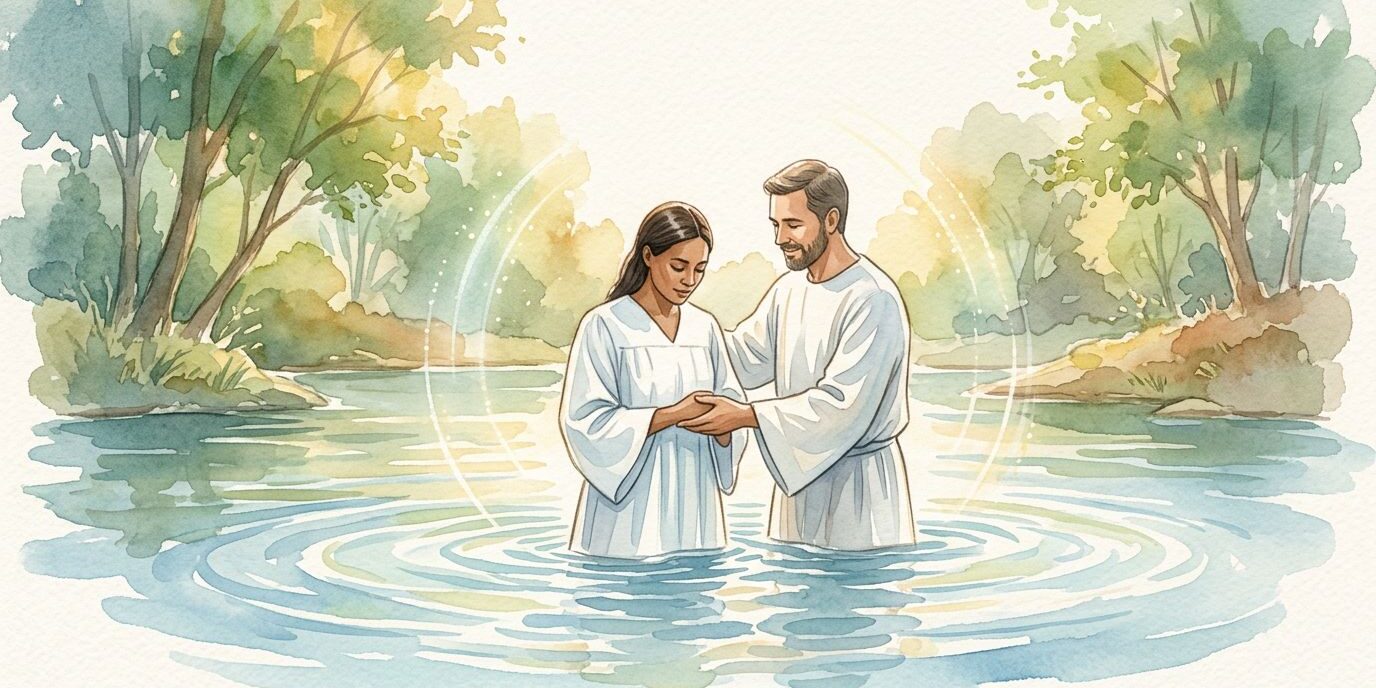
Water baptism is one of the clearest ways a believer shows faith in Jesus Christ. It serves as an outward sign of inward grace and a public declaration of faith, expressing a personal decision to trust Jesus Christ, turn from sin, and choose to follow Him publicly.
For many new believers, important questions naturally arise. Does the New Testament teach that water baptism grants eternal salvation, or is it an act of obedience? Why does a church baptize by immersion, and when should you take this step? The Bible gives clear answers, beginning with Christ’s command and the example of the early church.
Key Takeaways
- Water baptism is an act of obedience that follows personal faith in Jesus Christ.
- Going under the water pictures the death burial and resurrection of Jesus Christ, while rising pictures new life.
- Water baptism does not purchase salvation, but it serves as an outward sign of the salvation God has already given.
- Believers are baptized into the name of the Father, Son, and Holy Spirit.
- Any believer’s baptism should follow personal faith, and anyone considering this step should speak with a trusted church leader and prepare with prayer and understanding.
What Is Water Baptism?
Water baptism is a Christian practice in which a believer is placed under water and raised again. The act usually happens during a church service, although water baptism can take place wherever suitable water is available, much like ceremonial cleansings found in the Old Testament.
The word baptism comes from a Greek term connected with dipping or immersing. For this reason, many churches practice baptism by full immersion. This specific method of baptism by immersion vividly illustrates the picture Paul gives in Romans 6:3-4, where the believer identifies with Christ and His death, burial, and resurrection. Through this physical act, participants publicly mirror the death, burial, and resurrection of Jesus.
Jesus gave His disciples the command to make disciples and baptize them in the name of the Father, Son, and Holy Spirit in Matthew 28:19. This instruction given during the Great Commission places water baptism firmly within the normal pattern of Christian discipleship. Furthermore, the Great Commission connects this practice directly to the authority of the Father, Son, and Holy Spirit.

The New Testament book of Acts shows believers responding to the gospel through faith, repentance, and baptism. Throughout the New Testament, accounts like Acts 8 describe Philip explaining the good news about Jesus to an Ethiopian official. When they reached water, the man asked to be baptized, and Philip baptized him after an authentic conversion experience where the man confessed faith in Christ.
That account gives baptism a personal foundation rooted in New Testament teaching. A person should understand the gospel and respond to Jesus willingly. Baptism is more than a ceremony on a church calendar. It is a public act connected to personal faith.
Why Does Water Baptism Matter to Christians?
Jesus Christ was baptized by John the Baptist, even though He had no sin to confess. His baptism showed His willingness to identify with God’s purpose and begin His public ministry. When Jesus Christ later commanded His followers to baptize disciples, He gave the practice lasting importance, establishing water baptism as a foundational ordinance of the new covenant. Unlike the physical rituals and circumcision found in the Old Testament, this new covenant practice marks entry into a spiritual family.
For Christians, water baptism matters because it brings faith into the open. A private decision becomes a public declaration before family, friends, and the church. As a clear outward sign, it points directly to an inner spiritual reality. The believer declares, “I belong to Jesus Christ, and I intend to follow Him.”
This public declaration serves as an outward sign of a profound spiritual reality, drawing the individual into fellowship with the broader church community. Baptism gives the church a meaningful way to celebrate a person’s new life in Christ. The congregation witnesses a confession of faith and promises to encourage that believer. Christian faith grows in relationship with God, and welcoming new members strengthens the entire church community. Looking back to the promises of the Old Testament helps believers see how God’s plans culminate in the new covenant we enjoy today.
The act carries several biblical meanings:
- It shows obedience to Jesus’ command.
- It identifies the believer with Christ’s death and resurrection.
- It announces a new direction of life.
- It gives the church an opportunity to welcome and support a believer.
- It provides a public testimony of faith.
Water itself doesn’t wash away sin in a spiritual sense. Jesus’ sacrifice provides forgiveness, and faith receives that grace. Baptism points to what God has done through Christ.
Baptism is a visible confession that Jesus has changed the believer’s identity, hope, and direction.
Does Baptism Save You?
The Bible teaches that eternal salvation comes through God’s grace, received by faith in Jesus Christ. Ephesians 2:8-9 connects eternal salvation with grace and faith rather than human achievement. New Testament epistles consistently emphasize that a person cannot earn forgiveness through religious activity, including water baptism.
At the same time, Scripture treats water baptism as a serious response to saving faith. In Acts 2, Peter called the crowd to repent and believe after hearing the gospel. The early believers did not treat water baptism as an optional decoration added to Christianity, and they saw it as a natural step for those who possess saving faith.
This distinction helps answer a common concern regarding baptismal regeneration. Baptism doesn’t replace repentance, faith, or the renewing work of the Holy Spirit. The New Testament shows that the forgiveness of sins comes through Christ, and a person is baptized because he or she has trusted Jesus, not to persuade God to forgive sin.
First Peter 3:21 also requires careful reading. Peter connects the ordinance with salvation while clarifying that the act isn’t about removing dirt from the body. The New Testament passage points to an appeal to God through a clean conscience and the resurrection of Jesus Christ, completely rejecting the false doctrine of baptismal regeneration.
A helpful biblical order is:
- Hear the gospel.
- Believe in Jesus Christ.
- Repent and turn toward God.
- Receive new life through the Holy Spirit.
- Confess faith publicly through baptism.
- Continue growing as a disciple.
Baptism cannot make someone a Christian who has no faith in Christ. However, a believer who refuses baptism should examine the reason for that resistance. Jesus deserves willing obedience, and baptism is one of His direct commands.
What Does Baptism Symbolize?
The strongest symbol in water baptism is the picture of Christ and His death burial and resurrection. Going beneath the water points to the old life being buried, much like washing away sins, while rising from the water points to new life under the rule of Jesus. As you study the New Testament, you find that this imagery connects directly to the promises of the new covenant established by Christ.
This picture doesn’t mean the believer becomes perfect immediately. Christians still face temptation, weakness, and the need for daily repentance. Water baptism declares a new allegiance and direction, serving as an outward sign of entering the new covenant with God. The believer has turned toward Christ and wants His grace to shape every part of life, just as Old Testament prophets promised a time of inward transformation.
Baptism also symbolizes union with the body of Christ. A believer doesn’t follow Jesus as an isolated person. The church becomes a spiritual family that teaches, prays, serves, worships, and walks with one another.
The ceremony can also strengthen a believer’s memory of God’s faithfulness. Years later, a Christian may remember standing in the water and confessing faith in Jesus, sealing their commitment to the new covenant. That memory doesn’t replace ongoing faith, but it can remind the believer of an important decision.
Different Christian traditions explain certain details in different ways. Some practice infant baptism, connecting the rite to Old Testament covenant signs, while others practice believer’s baptism for people who personally profess faith. Some practice immersion, while others pour or sprinkle water to signify spiritual cleansing. This article reflects the pattern of believer’s baptism shown in many evangelical and non-denominational churches, where a person chooses water baptism after trusting Christ, following the clear examples recorded in the New Testament.
In traditions that practice infant baptism, families dedicate their children to God, whereas believer’s baptism is reserved for those old enough to understand the gospel. Looking back at Old Testament rituals of washing, we see a shadow of the spiritual cleansing that finds its ultimate fulfillment in Christ. The New Testament writers consistently show that personal faith comes first, followed by public water baptism as a testimony of inward spiritual cleansing.
The central meaning remains clear: Jesus saves, the believer responds through believer’s baptism, and the ordinance gives that personal response a public form.
Who Should Be Baptized?
A person should consider believer’s baptism after placing faith in Jesus Christ, experiencing an authentic personal conversion experience, and understanding what baptism means. Children and teenagers may be ready when they can express personal trust in Christ rather than repeating someone else’s decision.
Parents can help by asking simple questions:
- Who is Jesus?
- Why do you want to follow Him?
- What does baptism mean to you?
- Do you understand that baptism doesn’t earn salvation?
- Are you ready to tell others about your faith?
No one needs perfect Bible knowledge before believer’s baptism. New believers can continue learning for a lifetime. However, they should understand the gospel call to repent and believe, demonstrate genuine saving faith, and make a willing confession of faith.
A person who underwent infant baptism as a child may later choose believer’s baptism after personally trusting Christ. Churches differ in how they describe this step, so a conversation with a pastor in a local church can provide wise guidance without pressure. If you were dedicated through infant baptism, you might still pursue believer’s baptism as an adult public declaration.
You also don’t need a spotless past before believer’s baptism. The gospel is for people who need the forgiveness of sins and new life. A meaningful conversion experience often highlights this profound need. Baptism doesn’t announce that you have never failed, and leaders in your local church will remind you that it announces you depend on Jesus, want to follow Him, and trust in infant baptism alternatives only when founded on personal conviction.
What Happens During a Baptism Service?
Most baptism services begin with a short explanation of the water baptism practice. The pastor may ask the candidate to confess faith in Jesus Christ. A common declaration includes a statement that the person has received Jesus Christ and desires to follow Him through a public declaration.
During a typical baptism by immersion, the candidate enters the water. The pastor supports the person’s back and briefly lowers the believer beneath the water in the name of the Father, the Son, and the Holy Spirit. The believer rises as part of the water baptism experience, and the congregation often responds with prayer, worship, and celebration guided by the Holy Spirit.
Exact words and procedures vary by church. The meaning doesn’t depend on a special formula, a certain building, or the size of the crowd. What matters is the believer’s faith and obedience to Christ.
Practical preparation helps the day go smoothly. Wear clothing that won’t become see-through when wet, bring a towel and a change of clothes, and arrive early enough to receive instructions. Ask your local church about photographs, family seating, and any forms required before the service.
Most importantly, prepare your heart. Read passages such as Matthew 28:18-20, Acts 2:38-41, Acts 8:26-39, and Romans 6:1-4. Pray about your commitment, and ask questions if anything remains unclear.
If you are exploring baptism at a local church like Praise Chapel in Webster, Texas, you can contact Praise Chapel for prayer, information, and guidance from the church team. You can also call Praise Chapel at (281) 338-6633.
How Should You Live After Baptism?
Baptism begins a public journey of discipleship centered on Jesus Christ. After the ceremony, continue learning Scripture, praying, worshiping with other believers, and serving where God leads you as part of your commitment to a local church.
A baptized believer should remain connected to a local church through active church membership. Finding a supportive church community gives you encouragement when faith feels strong and support when life becomes difficult. Praise Chapel describes its church family as a place where people can come as they are and find practical biblical teaching, worship, and ministries for different generations.
Your baptism testimony may also help someone else consider Jesus. You don’t need a dramatic story to speak about God’s grace. You can share what you believed, why you chose baptism, and how you want to grow as a follower of Jesus Christ.
Baptism doesn’t remove every struggle, but it invites you into the responsibilities of the new covenant. Through church membership, you learn to live out this new covenant alongside others. The daily work of following Him includes learning to forgive, resisting sin with the power of the Holy Spirit, showing compassion, and trusting God.
When you remember your baptism and embrace your place in a local church, remember the promise it points toward. Your confidence rests in Christ’s death and resurrection, not in your ability to perform perfectly, and the Holy Spirit guides you every step of the way. Church membership deepens this walk as you grow alongside other believers.
Frequently Asked Questions
Do I need to be baptized to be saved?
No, eternal salvation is a free gift received through faith in Jesus Christ alone, not by human works or religious rituals. Water baptism is instead a vital act of obedience and a public confession that follows your personal decision to trust Him.
Why do most churches practice baptism by full immersion?
Immersion best mirrors the biblical imagery found in the New Testament, particularly the picture of Christ’s death, burial, and resurrection. Going under the water represents being buried with Christ, and rising up represents walking in new spiritual life.
Can I be baptized if I was sprinkled as an infant?
While many traditions practice infant dedication or baptism, believer’s baptism is meant for those who are old enough to personally understand the gospel and profess faith in Christ. If you were baptized as a baby, you can still choose to take this step as a public declaration of your own adult faith.
Conclusion
Water baptism matters because Jesus Christ commanded it and the early church practiced it as a response to faith. As an enduring symbol of the new covenant, it pictures burial and resurrection, announces a believer’s new allegiance, and welcomes that person into the life of the church in fulfillment of the Great Commission.
Water baptism doesn’t earn eternal salvation, but believer’s baptism gives your faith a public voice and serves as a joyful act of obedience. If you’ve trusted Jesus Christ and are considering believer’s baptism, speak with a pastor, pray honestly, and prepare to follow Him with a willing heart.